


Travel: camping and nomadism
July 11, 2023Recently, a friend asked me what I would recommend as gear for sleeping outdoors and in the car. I gave some quick advice, while realizing it was time to write up my camping and car nomad experiences. I'm writing this article as inspiration for others and also as documentation for myself, which will be permanently available on the internet.
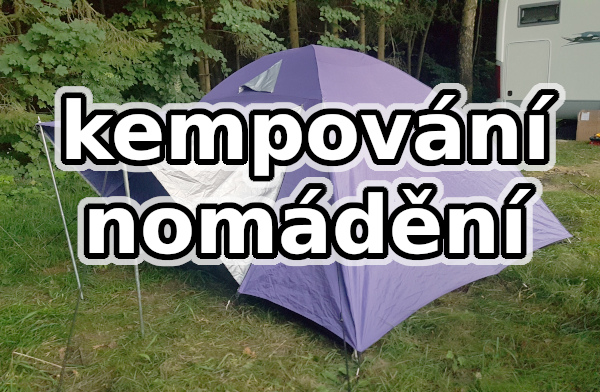
The moment you know what you need to travel camping style, prepare your facilities and learn how to camp,
you'll find that this way of travelling provides many more experiences, which are also unique and more interesting
than a simple holiday in a hotel by the sea.
Plus, as a digital nomad, you can still work while you do it, so you can explore new places, enjoy the outdoors and make money at the same time.
I've already written about how I've been nomadic in Poland in Wroclaw or on
Canary Islands in Las Palmas.
When people hear an exotic destination they have a vivid imagination, often picturing a holiday.
But most of the time it's different. When you travel nomadically, you have a similar setup to home and a similar routine, only with the advantage
that you can spend your free time exploring a foreign country or taking advantage of the local weather.
This makes it much more efficient if you want to travel and explore new places.
However, camping or nomading with a car is different. And for most people it's hard to imagine.
That's why I decided to pass on my experience.
Type of travel
You can travel on foot, by bike, by public transport or by your own vehicle. I like to travel in a car for tall drivers, which provides plenty of space. I can fit a lot of stuff in it, including my bike. You can sleep in it. People of average height sleep in it routinely, I only sleep in it in a pinch. So I put the important stuff in the car: sleeping bag, food, laptop and the Duratec Torain C1 29inch mountain bike, and the next day I can explore another place.
You can rent a cabin or a room while traveling. Or just sleep somewhere in the countryside, in a meadow or in a forest. In the woods you will appreciate especially the darkness and quiet. The middle way is to sleep in campsites, these have bigger and better facilities and therefore comfort. Plus, they still have the advantage that you don't have to arrange anything in advance.
The main advantages of travelling and camping with a car are:
- you can see more places
- it is significantly less expensive
- you can fit a lot of stuff in your car
After all, I have already written about how to travel cheaply.
The park4night website and mobile app can make finding a campsite easier. It shows campsites and car parks not only in the Czech Republic.
Equipment
The first thing to think about is what you need to carry with you and what you don't. Because without basic equipment you won't be able to function and at the same time you can't carry everything.
Kitchen equipment
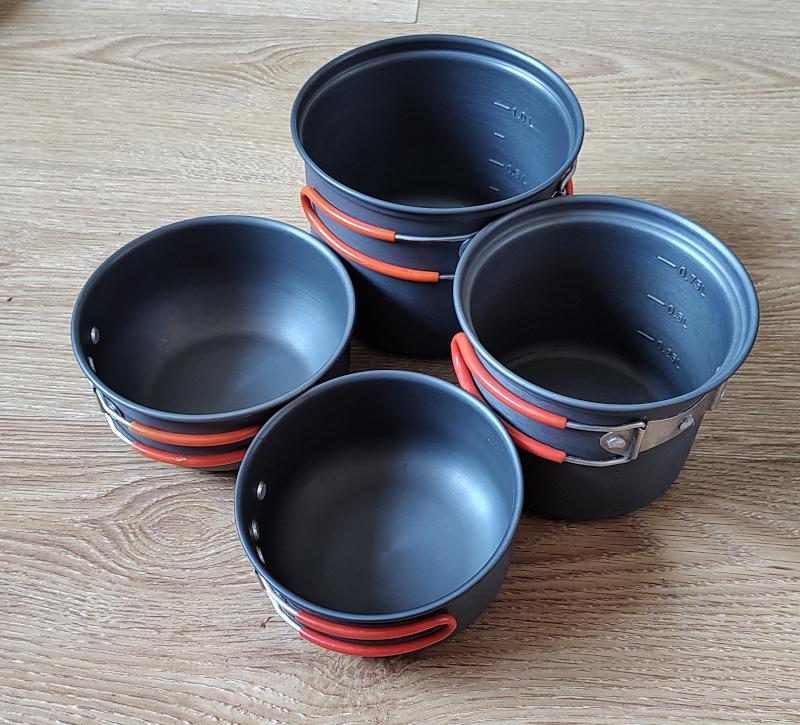
Mess tins, a stove with electronic ignition plus a gas canister are the basics for cooking.
I use a hiking stove and gas canisters, which can also be carried in a backpack when hiking.
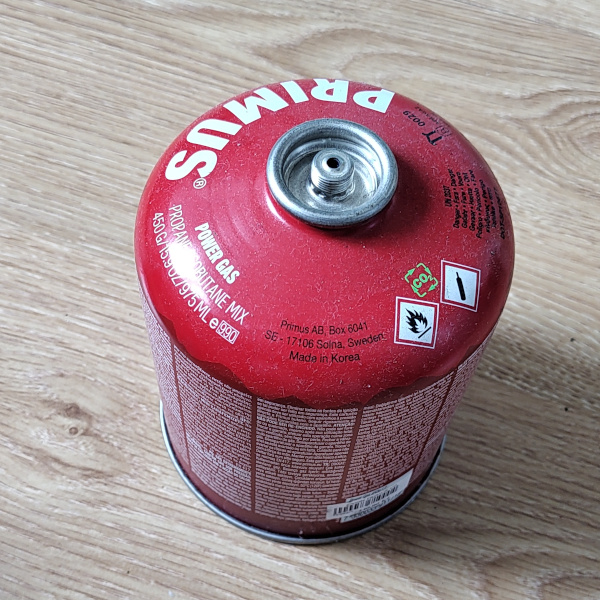
Gas canisters are typically sold in 100 g, 250 g or 500 g sizes. I buy the largest.
The smallest ones are good for hiking.
Of course, you can get larger stoves to fit on large gas cylinders, where the smallest is a 2 kg cylinder – this corresponds to the weight of the gas in the cylinder. The total weight of a full cylinder is greater.
Such a gas cylinder and stove is no longer a hiking item, but it is cheaper, so if travelling by car it is a good option.
They make different versions of both mess tins and stoves.
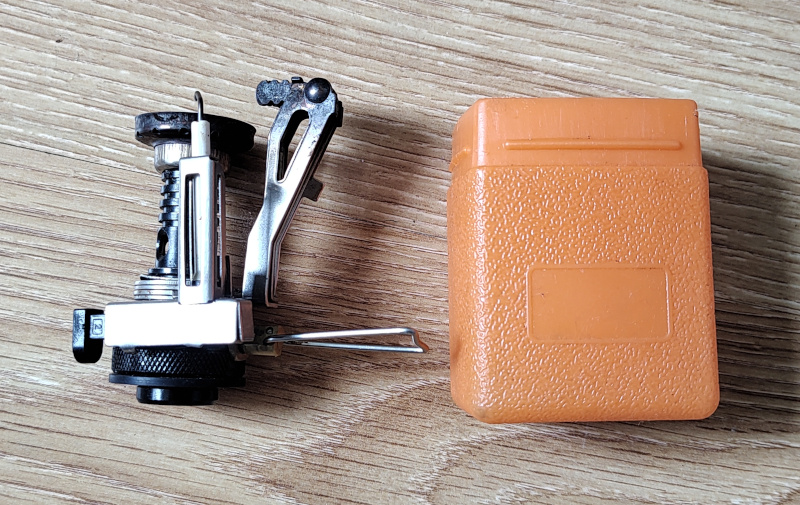
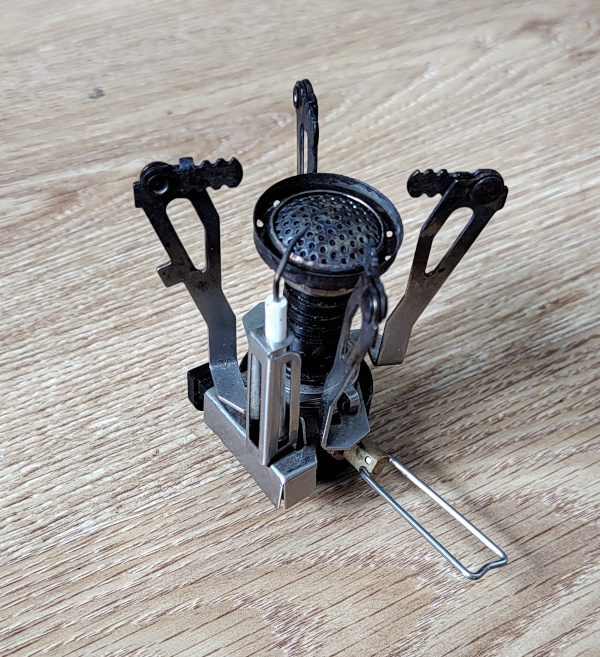
Here are pictures of my gear primarily for hiking:
A set of mess tins:
 Gas canister:
 Folded stove. Such a folding stove is ideal for hiking.
 Stove:
 Stove mounted on a gas canister:
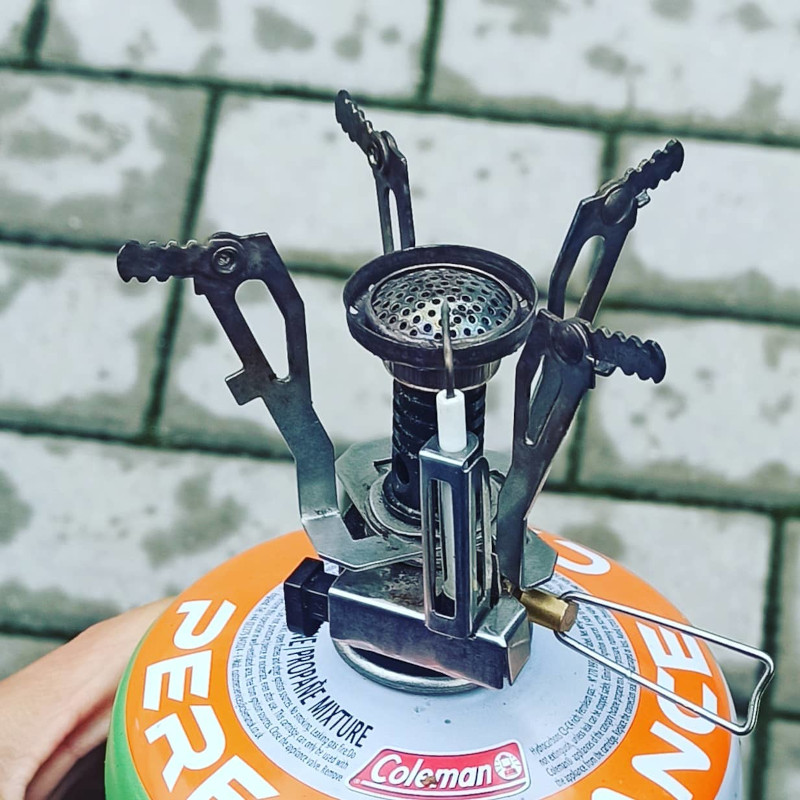
The price of the mess tins was about CZK 800, the stove CZK 100, the canister from CZK 100.
Definitely get a stove with electronic ignition, because then you don't have to deal with matches or a lighter!
Survival kit
A survival kit, abbreviated KPZ in Czech, is a box where you keep things that help you solve problems that come up. In this box I place:
- scissors, thread, needle
- a safety pin
- matches
- ibuprofen
Ibuprofen comes in handy the moment you feel sick and need to get somewhere. Or when you have had a hard day and you have a headache; after ibuprofen you will sleep better in such a situation and thanks to that you recover properly and are able to function again the next day.
Equipment
If you sleep in a tent or under the open sky, you will need this equipment:
- tent
- sleeping bag
- sleeping mat - regular or inflatable
- a pillow is useful for car journeys
- utensils: large and small spoon, fork
- sharp knife
- strainer
- folding stool
- trekking sticks
- headlamp/torch
- tick extraction tool
- when sleeping under the open sky: a tarp to sleep on and one over you against the rain
- insect spray
- toilet paper
- folding shovel
- folding toothbrush
- plastic slippers (no sandals needed)
- functional long tank top and underpants
- waterproof document case.
- sunscreen
- blanket
- food boxes
- small lock - for example, in Spain it was useful for locking a locker on the beach
- wire for various uses
- thermo box
- a towel
I use the thermo box by freezing two 1.5l PET bottles, and then for about 2 days the food in the thermo box lasts like in the fridge, if the thermo box is in the shade.
Things
A list of things I always carry with me on any trip. And this list serves as my checklist.
On the road
A basic list of things for any trip:
- mobile
- USB power supply (charger)
- headphones
- powerbank
- USB-Ethernet adapter, if you don't have an RJ45 connector for Ethernet on your laptop
- food, drinks
- spoon
- pyjamas
- laptop
- earplugs
- toothbrush
- tissues
Longer journeys
For longer trips in addition:
- replacement glasses (contact lenses)
- action camera + accessories – I have Eken H9R
- handsfree pole, possibly a stand and external microphone
- cycling jersey. Fits all sports and represents.
To make my free time more interesting I take:
- books
- board games
- puzzle games
Bike touring
With me for cycling tourism:
- bike phone holder
- bike light
- a supply of spare inner tubes
- lock
- replacement brake pads
- chain cleaner, cleaning brushes, cleaning agent
- oil
- 2x cycling shoes
- cycling gloves and head scarf
- helmet
- light and blinker
- cycling jersey
Here you will find GPS route records from my trips.
Power
I carry a 10k mAh powerbank that lasts 5 to 7 days for charging the phone if the phone is only used occasionally as a map. However, it typically lasts me a maximum of 3 days with active use.
I started carrying around an old car battery that I use to charge my laptop.
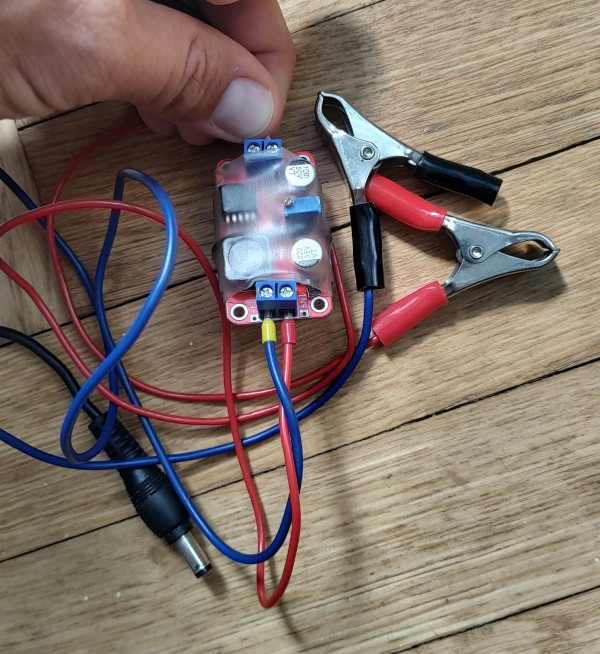
In order to charge the laptop I use a step-up pulse power supply that makes 19 V from 12 V.
On one side I have crocodile clips that I attach to the car battery, and to the output I soldered a connector that fits
my laptop.
Originally there was an atypical connector for the
Lenovo ThinkPad X1 Carbon laptop.
I currently have a standard round connector there, the one the TUXEDO Pulse 15 laptop uses for power.
Device photo:
If you would like to know how such a step-up or step-down pulse power supply works, read the article:
Special USB power supply reducer.
Step-up pulse power supply and power supply for Lenovo ThinkPad X1 Carbon laptop from car battery:
@josefjebavy How do I power my laptop when travelling? #notebook #battery #nomad ♬ original sound - Josef Jebavý
For trekking/camping
Especially when travelling, you need to think about food. And when it comes to spending your time actively, e.g. hiking, sports etc., food is the most important thing, so you need to think about your diet and arrange yourself accordingly.
The basic thing is to have enough water with you. For trekking trips it is ideal to use 1.5l PET bottles. I also carry water in bottles in my car. Another option is to have 5l water cans in the car, for example.
Food
As a staple food, I have found that basic quality foods provide the necessary nutrients during challenging days and are easy to prepare. They are:
- cottage
- banana
- olive oil
- Asian rice noodles
- corn pasta
- Balkan cheese
- gouda cheese
- basil, lovage
- salt, pepper
- cranberries, raisins
- preserved fruit
- peach, grapes
- juice
- onions
- loose-leaf tea
When travelling in summer, there are often opportunities to pick fresh fruit. Depending on the season, it's always worth watching whether there are ripe strawberries, cherries, apricots, apples, etc. around. When travelling in a car with several people, it can be interesting to take a grill with you and cook a steak on it. With that I'll cook potatoes or rice, of course.
You also need to remember sources of fibre, and therefore provide yourself with vegetables. I like to buy cucumber or iceberg lettuce. From the lettuce I can even make a delicious salad with onion, oil and Balkan cheese or mozzarella while on the go.
As a dietary supplement, I always carry vitamin C, which is a great antioxidant and helps with recovery after a tough bike ride.
For emergency food I have a tin of beans or a tin of fish which I eat with onions and bread.
I eat bananas or other fruit during the trip and then when I get back to the campsite.
Then I have cottage cheese because it is a great source of fast protein, so I use it as a better protein
supplement.
Then I have a big main meal.
For breakfast I typically cook rice pasta, to which I add olive oil, onion, Balkan (feta) cheese and gouda.
I season it with lovage or basil and of course salt and pepper.
For dinner I make corn pasta with similar ingredients.
If fresh corn is available I cook and eat pasta with it as well.
Definitely don't forget to replenish salt, because if you have an active day, you will have increased salt consumption and salt is
essential for the body to function.
Sometimes I cook porridge: 1/4 l of milk and 5 handfuls of oats. After cooking I add fresh fruit or raisins or jam to it.
Fried or boiled eggs are good to make in a mess tin. Or try making an omelette as well.
Again, eggs are a great source of energy and protein.
Showering
Outside the campsites, I wash in a river or a pond. In an emergency, if I don't have a body of water nearby, I pour water over myself from a bottle. A good option is to poke holes in a PET bottle cap so you can turn the bottle into a shower.
Internet and communication
Internet connectivity is one of the basic conditions for functioning today.
In other countries (Poland, Austria, Spain) it is cheap to buy a prepaid SIM card with enough data for work,
unless you need to download large amounts of data.
In the Czech Republic, I've been using an O2 prepaid SIM with the Datamania service since 2021, which includes 100 GB of data per month for CZK 300 (CZK 350 from summer 2023).
(This card is typically sold once a year by O2 in August.)
Otherwise, of course, in campsites, Internet connections are typically problematic and expensive.
For communicating with the Czech authorities, I found it handy to have a Databox service set up. Within the EU, your Czech tariff works under the same conditions/prices.
The advantage of camping in the countryside
If you camp in the countryside, such as a meadow amongst the woods, you will have absolute peace of mind.
Especially sleeping in such a place is very good because it is quiet and absolutely dark.
In the Czech Republic there is also the advantage that unless it is a place that is private or overnight camping is forbidden,
you can sleep there.
So just take out a sleeping mat and a sleeping bag and you can sleep in the fresh air under the open sky.
You can then make breakfast quickly and easily on the gas stove without having to modify the place.
You need to choose a place that is far away from human habitation, away from places where people normally walk at night, so that you
won't be in anybody's way and no one will disturb you.
The ideal place is away from houses, away from main roads, somewhere among trees or woods, or in the woods on some dead end road or clearing.
Preferably in a little valley, because there you can't be seen and the wind doesn't blow.
It's especially ideal if you choose a place where the sun shines on you in the morning, or from which it's easy to move after waking up
to a place where the sun shines in the morning.
If you are moving by car, it is more difficult to find a suitable spot. Ideally, you should map it out in advance.
Often, it's a good idea to look for a spot along a dirt road.
If you don't know where to park and spend the night, a campsite where you can also refill your water supply and recharge your battery is a sure bet.
The advantage of a campsite is that you don't have to arrange a spot in advance.
Campsites vary: cheap/expensive, ugly/pretty, crowded and noisy or tucked away half empty and quiet.
Always consider the conditions and where you are staying! Under certain conditions, it is possible to bivouac even in a protected landscape area.
Nomading
If I'm going on a long stay somewhere abroad, I typically rent a room or apartment.
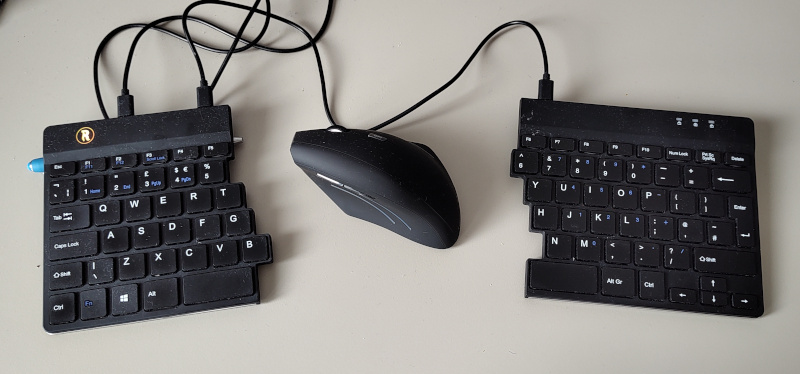
Then I bring along a monitor, an external keyboard and a vertical mouse.
Photo of the two-piece keyboard and vertical wireless mouse:
I usually look for accommodation through Airbnb because it's an easy and efficient way to find something.
A service like Airbnb makes it really easy to travel because finding and securing accommodation is very
simple.
You can choose between short and long stays, you can search last minute or plan ahead.
Plus, you can stay with locals and be closer to the local culture.
My opinion is that Airbnb has revolutionised accommodation and therefore travel.
Video
Photos
For more photos from my travels, check out my Instagram: www.instagram.com/josefjebavy.
Exploring the Place
If you want to get to know a new location, I would recommend using a bike,
because with it you can get around much faster than on foot, yet it's just as flexible and gets through easily, unlike
a cumbersome automobile.
@josefjebavy #travel #nomad #swimming #it #bar #shopping #park #cycling ♬ original sound - Josef Jebavý
Other Resources
Articles on a similar topic
Business trip to Warsaw and training at Deepspot
Nomadism in Thailand in Pattaya
Visit to Poznan
Excursion to Athens and a catamaran cruise
Germany, Sazko, Dresden
Nomadism in Wroclaw
Nomadism in Las Palmas
Payments in foreign currencies when travelling and online
How to start travelling. Where to get time and money?
Newsletter
If you are interested in receiving occasional news by email.
You can register by filling in your email
news subscription.
+