



How to start a freelance business the right way
April 14, 2026I have been in business as an independent consultant for many years. I am a so-called freelancer or freelancer. In that time I have had the opportunity to learn a lot and recently I have been sharing this experience in personal meetings. And because the IT job and business market is changing, nowadays thanks to AI for example, people come to me asking for business and freelancing advice. In order to pass on my knowledge effectively, I decided to convey the most important information in the form of this article.
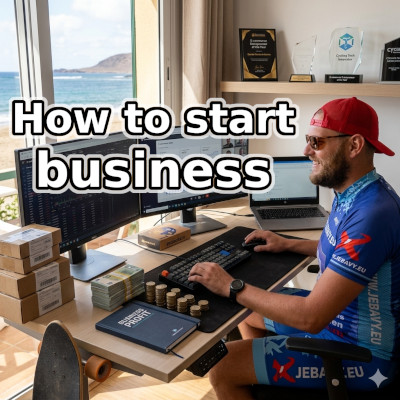
I was very active from childhood, I went to art school, was into aquaristics (fish propagation and plant cultivation), built and designed my own model airplanes that fly, built and designed electronic devices from blinkers to speaker cabinets, amplifiers and other electronics and helped others. However, it never occurred to me that I could run a business. I always lived under the idea that I would be employed and that someone would tell me what was needed and what to do.
The Czech Republic is a post-communist country, so for a long period before 1989, entrepreneurship was basically non-existent. That's why it didn't even occur to me to do business. However, due to my skill and diligence, already at school age and later on in employment I helped others to meet their needs, often for free or below cost, because I did not understand the market.
In employment, I found it common that many things are done inefficiently and that business owners often don't know how to do things technically or business-wise. Companies founded just after 1989, or rather their owners, proceeded by trial and error, and they took hold in the market because of that, because nobody was doing business before and the market was free. They, unlike others, had the courage to try it, though without knowledge of the industry or entrepreneurship. The experts stayed in the position of an employee because they understood the risks of the industry, whether it was construction, electronics or software development.
When I saw companies delivering low-quality services, I realized that succeeding in this market would be a piece of cake for me, because I have excellent expertise, I just need to become active and learn business skills.
Then when I was asked by a commercial firm to do a project for money, my father said: "Start a business." And I went and became a sole trader.
What is entrepreneurship
A business is a systematic activity carried on independently in one's own name for profit. At the same time, you accept some risk, but on the other hand, all the rewards are yours. You have the freedom of how you carry out the activity, but it is also your responsibility.
Shvarc system
Not infrequently, I've come across someone operating officially as an entrepreneur but actually operating as an employee. That's what's called the shvarc system (disguised employment) and the state doesn't like it because it means less money for the state. I don't care how someone officially works. However, let's face it, when someone works this way, it's not a business. Often, even for a person who legally works as self-employed for a single supplier (the typical term is contractor), it can't be called a real business, because he's not working as a professional partner, but in a subordinate role.
I describe more details about the ways of collaboration in the video:
5 Types of Work Collaboration:
Who is a freelancer?
A freelancer is an entrepreneurial individual, who chooses work/clients based on their preferences. And it often chooses a project as follows:
- he must be interested in the industry or technology
- chooses a project in whose technology he sees the future, so practical experience with that technology will be useful
- doesn't work for people/companies he finds unpleasant etc.
Basic video with information: How to freelance:
The importance of the independent entrepreneurial individual
An independent entrepreneurial individual, or freelancer, is a key element of flexibility and innovation in the modern economy. Its importance lies primarily in its ability to respond quickly to changing market needs and to offer highly specialised expertise without the administrative burden of large corporations. For companies, freelancers are strategic partners, they enable efficient scaling of projects and bring a fresh, external perspective. On a society-wide level, these individuals embody the democratization of work and personal responsibility. Freelancers are micro-entrepreneurs who, through their adaptability, increase the resilience of the economy to crises and, through their freedom, often push the boundaries of creativity and digital transformation.
Some people are in business for the money, but that's not how real freelancers are.
Whatever a person does, it's more enjoyable to do an activity because you enjoy it and because it fulfills someone's wishes.
Running a business just for money, or because someone forces him to, is not the ideal solution.
Personally, I run a business because I have gradually come to the conclusion
that this is how I can provide the best and highest level of service to people and businesses in my area.
When to start a business
A lot of people want to start a business. But if you want to start something, it's a good idea to plan it well.
You don't need to dive headfirst into business,
but to think it through a bit and get the ball rolling.
On the other hand, you also need to take some risks, otherwise it wouldn't even be a business.
How to ideally start a business? If you are employed and decide to quit your job and start a business without preparation, this is the worst course of action.
The ideal course of action is to start a business as a side job while studying or working,
or get a part-time job or contracting.
Yes, doing multiple things at the same time is hard. After all, all beginnings are hard.
Once the business takes off, you need to quit your job and shift all your time and mental energy
to the business, because otherwise the job will just hold you back.
If you are employed at a company that does IT, and you want to do business in IT too (in the same field), you need permission from your employer. That's why it's easier to start a business for those who work on shvarc for a start, or be employed by a company that is in a different field.
It is often good to do something else as a job and something else as an entrepreneur. Feel free to have a job as a server administrator and do programming as a freelancer. Because it's a slightly different field, it won't exhaust you mentally as much.
The biggest risk you take is when you start a business and just have it as your main activity. Then if you don't get contracts, you still have to pay government fees (social and health). That's why it's better to have the business as a side activity at the beginning, or to be sure of some kind of regular, larger collaboration.
How do I choose what to do?
There are people who go into business without knowing exactly what they are going to do. But you should always go into business knowing what you're going to do, even though it's bound to change afterwards...
Ideally, it makes sense to do something you know how to do, and at the same time people want it and will pay for it. Conversely, it doesn't make sense to do what you don't want to do, or what you can't do, or what people don't want and won't pay for. However, it's not so dogmatic because you can approach it creatively. As a freelancer, you can also offer what you are able to learn on the fly. Companies can't learn new things quickly, but a freelancer can. And that's exactly what my clients appreciate: that I'm able to learn new things.
I describe in more detail the choice of what kind of job and business to choose in my video: How to land a good job:
For example, I chose not to work with Windows, because it's a low-quality solution, where Windows just brings problems to customers and stress to me. I prefer to deliver quality solutions, so I deliver solutions built on the operating system Linux.
Administrative Minimum
Or how to deal with bureaucracy or paperwork.
This section is purely about administration according to the regulations of the Czech Republic.
You go to the Trade Licensing Office, there for a fee of 1000 CZK you set up a trade and you are already a sole trader.
Nowadays, the trade office will automatically register you with the
Czech Social Security Administration (CSSZ) and with your health insurance company.
If you have a side business, you don't even have to pay an advance payment to the CSSZ and the health insurance company.
I won't go into detail here, because there are
many articles on the internet about starting a business.
For the record, it's a good idea to set up a separate account for your business as well. But it's not a requirement. But you definitely don't have to pay for an account that's called a "business" account.
Once a year you will then file a tax return (DAP) and reports to the CSSZ and the health insurance company.
Filing is done electronically these days, so it's pretty quick.
And once you've tried it once you'll find that the second time is easy.
All communication with the authorities today can be done digitally via a data box.
So then you can operate fully remote.
Sole trader (OSVČ) vs company
Freelancer is a general description of a type of business.
The official form of business in the Czech Republic is a sole trader (OSVČ), or you can do it as a company (s.r.o.),
or under the Copyright Act. Mainly it then has to do with accounting and taxes.
Due to the fact that there are more options, I get asked regularly at consultations:
should I start a business as a sole trader (OSVČ) or a company (s.r.o.)?
For a person who programs custom software, supplies know-how, provides training and consulting,
a sole trader (OSVČ) is definitely the better choice. Why?
The sole trader does not have to deal with accounting (formerly known as double-entry bookkeeping), which an s.r.o. has to deal with.
An OSVČ only keeps tax records (formerly referred to as simple accounting).
This therefore means less paperwork.
A sole trader can use flat-rate expenses (or the flat tax). This makes for less paperwork and is also tax efficient up to an income of 2 million.
When does it make sense to set up a company?
There are obviously many situations where it makes sense to set up a company. However, these will be situations where you are no longer operating as a freelancer but, for example, as an agency.
Here are some situations where it makes sense to start a company:
- you employ other people or have subcontractors
- you resell goods
- separation of risk
Often a company is taken as more trustworthy. However, when I compare an s.r.o. and a sole trader, a sole trader is liable with all their assets, which is a greater risk than, say, with an s.r.o., which has zero base assets and a capital of 100,000 CZK, which it has already spent. So for me, an s.r.o. is actually less trustworthy than a sole trader.
As for the risks a sole trader may have from the work
they do, unless they sign some kind of nonsensical contract,
the biggest risk is if you deliberately cause some damage, which I assume you don't plan to do.
Logically, you can't be held liable for damage caused by an attacker,
unless, of course, you commit to the claim that the solution you provide is safe and functional in any situation, even one that hasn't occurred to anyone yet.
Of course, I'm not a lawyer, so my interpretation may be simplified.
Registered office
If you want to have your business's registered office somewhere other than your home address, for example because you live in a rental, you can use what's called a virtual office and the services that come with it. Virtual office is offered by many companies today.
VAT liability
There is no point in becoming a voluntary VAT payer unless you are reselling services or goods from VAT payers.
The situation where it makes sense to become VAT registered is if you would have large costs from VAT payers,
then it may be advantageous to be VAT registered.
If your typical customers are end-users, i.e. ordinary citizens,
then you wouldn't even want to be VAT registered,
because if you do become VAT-registered,
then automatically your services are 21% more expensive or your income is reduced if you keep the price for the end consumer the same.
For example, if you
provide short-term accommodation
you suddenly have to pay VAT on that remuneration completely unnecessarily.
If your income and expenses are more complicated, then it's a good idea to do the math. Or a tax advisor can calculate it for you.
I am not a tax advisor.
Differences between agency vs freelancer
What is an agency?
The classic term agency (or more commonly employment agency) is a company,
that acts as an intermediary in the labour market.
It employs people but they are actually working for another company.
In IT, such activity is referred to as bodyshopping.
It means pre-selling people. And in IT it is typically not employees, but people who do the billing. So often it's shvarc.
In IT, the term agency refers to a company to which IT work is outsourced. Either such a firm supplies some expertise or some solution. Often it is able to provide customized development of a large software application.
Comparison of IT agency and freelancer
People often compare an agency with a freelancer.
Commonly people are of the opinion that a company/agency is always better than a freelancer. I fundamentally disagree with that!
Of course, a lot depends on the particular entity.
In general, an agency can have only one advantage, and that is that it can have more capacity, or rather, it can scale the work.
At the same time, it's like comparing apples with pears,
there are many differences between these entities, and therefore they may not even be in great competition with each other.
And that's why a capable freelancer establishes themselves perfectly well in the market, even if there are agencies around.
Typical characteristics of a freelancer
A freelancer typically offers: speed, flexibility, expertise, individual approach, ability to learn new things and deliver innovative solutions.
A lower hourly rate is often expected. But a freelancer can be much more expert and much more efficient,
so they can end up with a higher hourly rate than an agency and end up cheaper.
Yes, statistically an agency has to pay for more unbilled work around it, so the lowest hourly rates of agencies have to start higher than the lowest hourly rates of freelancers,
otherwise such an agency wouldn't even survive economically.
A freelancer creates and uses a personal brand.
Typical agency characteristics
Agencies are often expected to be professional. But sooner or later, the expert leaves the agency and is replaced by someone else. Or the agency charges an expert but a novice works on the assignment.
The main advantage of an agency is scalability.
That is, unless the agency is small. Then it can put more people on the job, and therefore handle more work than an individual - which is the only real advantage of an agency.
An agency should be able to handle large projects, but this is often a problem even for established companies,
because the multiple layers of management create a problem of awareness and real managers are few and expensive.
So they hire someone to manage who is simply willing to communicate and put up with unpleasant communication from above, below and from the customer.
Capable companies therefore use agile development practices when developing custom software.
Agencies can create any brand that is actually artificial.
Where do you get your first clients?
Whether you're a budding or advanced entrepreneur, you'll always ask yourself: where do I get new clients?
Practical ways that work:
- Personal network: write to all friends and former colleagues. Ideally those who are in business.
- Specialist portals: Navolnenoze.cz, LinkedIn, webtrh.cz
- Content marketing: building an expert name through social media posts.
Employees from the corporation often work for the corporation as well or take over customers from the corporation. (This is actually the principle of using existing contacts.) When going from corporate to freelance, the work mode is different and there are entirely new skills to learn and different ways to function.
My advice video: 5 basic ways to find new customers:
@josefjebavy how do you as an entrepreneur hustle for business? #podnikani #marketing #zakazky ♬ original sound - Josef Jebavý
I often see people talking about clients/customers. But they forget that the customer is only who you have agreed to work with. Until then, it's just a person/company finding out information about a potential collaboration. And you need to have a well-designed process for turning an inquirer into a customer. Otherwise, you may end up working on a task that no one actually wants yet. The ideal differentiator is the payment of a deposit.
Running a business
Once you've been in business for a long time, getting contracts tends to be a little easier.
One reason is that you already know how to walk the walk, another reason is that you're already in a better starting position...
Customers will keep coming back to you, or they will return based on being reminded of you.
A referral or project handover from a fellow freelancer is common. In the case of a referral, the contact is already pre-heated, so arranging a collaboration is usually easy.
The advantage of a freelancer compared to an agency is that they don't need to constantly find a large number of new clients, typically just a few smaller ones and two larger ones per year. This is because a freelancer has a limited capacity and is continuously working on projects for older clients as well.
I'm planning a separate article and video on customer acquisition.
Personally, for more effective communication, I wrote down the process of arranging and initiating a collaboration so that I know how I want to do it and can effectively convey this information to inquirers.
Customer/Order Types
Often people imagine that a freelancer works for one client, but this is often shvarc and not a business.
Or they imagine that they're working on one one-off task after another, each time for a different client.
What does the job of such a typical IT freelancer look like in reality? It is diverse.
Here are the typical jobs that a combined freelancer works on:
- Long-term regular cooperation
- One-off jobs
- Packaged service (package)
- Recurring repeat work from the same customer
Propagation
From the preceding paragraphs, you probably gathered that, unlike an employee, a job will not "come" to you on its own.
And even if some new work comes to you on its own, it's because of your previous activity.
So that you get more new work, quality work, and are better able to convince the enquirer,
that you're the right guy, you need to do promotion or marketing.
Please do not confuse marketing with advertising. Advertising is just part of marketing. But not a necessary part.
Promoting your services will ensure that people know about you and know what you do.
The reality is that there are an extreme number of smart and hardworking people in the Czech Republic.
But because they never tell the world what they do, they are not known.
On the contrary, there are people who, in the style of the USA, pretend to be good, but in reality they can only promise and do not even know if they can implement it.
So it's a good idea to make at least a small marketing plan to start with.
Think about which way of communicating with the public suits you and on which communication channel you will find potential customers.
Since IT professionals such as software developers and server administrators are introverts,
they'll be comfortable with the written form, so they can write professional blog articles or LinkedIn posts.
Since a freelancer's customer is typically a business person, the article should be tuned not only technically,
but also in a business way, i.e. emphasizing, for example, time savings and increased profits.
Every entrepreneur should have their own website on their own domain and with their own email.
And even if it's just a business card website. Such a business card can be generated as a static page by AI today.
Having your own website doesn't just mean you have a page of promotion, but it's your space,
that you have full control over, no one can take it away from you and you can customize it however you want.
Creating content for your own site also allows you to think through what you are offering and how to communicate it to enquirers.
If you're not a designer, you don't even need to have a modern and dazzling website.
However, it is important to review your content regularly, as a typical weakness of any website or profile on any portal
is that the information there is out of date and doesn't reflect reality at all.
I described why to have your own website in detail in the video:
"8 reasons to have your own website":
Want to get a business card?
Business cards are not essential today,
but there are places where they're expected, so they come in handy – conferences, for example. Plus, the other person can make a note right on the card.
However, in today's digital form, you can only pass on a digital contact such as a web link or phone number.
Or have a QR code printed out, where the digital business card and therefore all the contacts will be on you.
Or you can get a special business card like wavetag,
which is a combination physical business card that includes NFC and a QR code with a link to a web-based business card.
For details, see the video "wavetag: user and business review":
Among other promotional channels, you can then use Facebook or YouTube.
How to set your price
The easiest and most typical way is to invoice work by the hour. However, as an entrepreneur, it's a good idea to try to get to a point where you can sell a task at a well-defined fixed price or have a set of services with a fixed price as a package.
Everybody likes a fixed price and if you are the one setting that price and you can actually determine it well, then selling at a fixed price is to your advantage.
The customer is assured of a fixed price and you get more reward than if you were billing by the hour.
Of course, that means you can do a good analysis, underwrite the risks, price the job correctly and work efficiently.
Because with experience and automation, you can deliver the job in a fraction of the time of others and still get it done cheaper than the competition
and you can deliver the job faster.
However, if the customer sets the price themselves, you don't deliver the documents and you don't have the ability to do the analysis, then offering a fixed price is gambling and insanity.
For example, if someone comes to me and wants to migrate an application from one server to another, I don't do it for a fixed price,
because even though I can successfully migrate what the author doesn't want to touch anymore,
the lack of documentation and administration around the domain can be such a risk due to skeletons,
that even a simple application migration can drag on for many hours of communication.
A migration deadline without proper preparation can also drag on for many weeks.
Similarly, if someone wants to develop custom software and has a description of features in one paragraph, there is no way to put a price on it.
And it is necessary to first analyze the requirements, define the features and design the architecture.
How much to charge
As an entrepreneur, you need to base yourself on three basic things:
- When you calculate your living expenses and the cost of doing business, you should have enough income to support you without any problems and still build up a reserve.
- What value will your work bring to the customer? You won't bring much value to an individual. After all, an individual should buy a ready-made solution. With a corporation, you have to take corporate politics into account. But young, progressive companies appreciate the huge savings in time and the money saved or earned. And if the owner is the one making the decision, they can often evaluate very well what your work will bring them.
- Last but not least, the service being delivered will not be so unique that no one else is offering a similar service in the market. So any enquirer will also compare your price with the market, and your price can only stand out if there are compelling reasons for it.
Pricing is a very individual thing and depends mainly on the specific situation of the freelancer and the inquirer. If you would like to discuss your specific situation and pricing, I can offer you an individual consultation.
Hourly rate employee vs entrepreneur
Consider that an employee is paid for all time spent at work. A sole proprietor, however, may bill the customer for much less time. For example, you may work 8 hours, but only 4 hours of that is net work for the customer that can be reported and billed.
As an entrepreneur, you also have to buy your own equipment: notebook, phone, etc. You often have to educate yourself in your spare time, and you pay for other costs yourself, such as an accountant, web hosting and other services. A sole trader also doesn't have paid holidays.
So, compared to an employee, a sole trader can realistically work less while incurring much higher costs. And you need to price correctly accordingly. It's nicely and very honestly described in the video: How much does an hour of freelance work really cost?
Paying a deposit
The most typical and biggest risk is non-payment of invoices. However, this can easily be solved by taking a deposit, or by invoicing in small instalments.
(Especially for VAT payers before 2025, an unpaid invoice was a bigger problem...)
Why do I require a deposit on the work?
Paying a deposit is a signal to me that the customer is confirming their serious interest in working with me.
Incidentally, when I bought a Duratec bike, I also paid a 50% deposit upfront and the rest directly upon delivery.
How to work with deposits on a job would make for a separate article. For those who have trouble asking for a deposit and are wondering how to incorporate deposits into their business process, I offer one-on-one consultations.
Working with Business Risk
Business is not only about freedom, but also about being responsible for risks that you don't feel as much as an employee. Here are a few key areas to manage them:
- Reserves for a rainy day: You need to expect that you won't be reimbursed when you are sick. A financial cushion is an absolute essential for a sound sleep.
- Diversification: Having multiple customers is safer than putting everything on one card. If one drops out, it won't ruin you.
- Deposits: For new or large projects, don't be afraid to take deposits in advance. It covers your costs and time.
- Work Scheduling: Ideally, you want to combine flat-rate collaboration (a certain monthly income) with work arranged in advance, so that you have a full calendar.
Tools
An IT professional knows what tools to use to effectively develop software or manage a server. For example, every developer had to learn how to use the Git tool.
As for other tools, I can recommend Toggl for time tracking and Fakturoid for invoicing.
Time-management
Or work efficiently so you don't burn out.
To avoid getting overloaded and burnt out, you need to learn to say "no".
It's good to plan ahead what you're going to do.
Some people are comfortable with having everything exactly on a calendar, but I personally only put things on the calendar that are fixed to a specific time.
Develop rituals
Rituals will help you switch your brain into work mode. For example:
- Playing certain music when you start working.
- Morning walk before sitting down at your desk.
- Consistently turning off the computer at the end of the workday (or at a certain hour) and then taking a walk outside to ritually end the work process.
Don't forget to take breaks. It will refresh your brain and you'll not only feel better, but also function better. And most importantly, don't forget to eat and drink in the heat of the moment!
Meeting planning video: "5 tips to plan an effective meeting"
Business Advantage
People see a lot of advantages in entrepreneurship such as time freedom and money, but at the same time there is hard work hidden behind it. Personally, I see the advantage in the fact that, unlike employment, you have the opportunity and motivation to grow professionally and you can work much more efficiently while running a business, and often keep doing it for much longer than you could stay working as an employee.
What is the most important thing in business?
In my opinion, the most important thing is to maintain good health and motivation to work for the long term. In order to have good health, you need to be healthy in the first place, and in order to stay motivated, you need to enjoy your work. You will achieve all of this if you do business the right way.
Freelancing is a way of life
Freelancing is a marathon, not a sprint. You need to gradually learn and re-evaluate your strategy. In the long run, however, it provides greater security and plenty of other benefits. You just need to do business the right way.
If you follow the path of entrepreneurship, you can follow a laborious but successful path like Martin Háze,
who sums up his path to entrepreneurship this way:
My goal was to make a living doing what I really enjoy – primarily sports massage.
After several years of working as a masseur at the military recovery centre in Špindlerův Mlýn,
I decided to take the next step and start my own business as a sole trader.
I didn't find much support in the area, but luckily I had at least a few people around me
who motivated me and helped me get on the right track.
One of the most important was Pepa.
He supported me not only personally, but also practically – he advised me
how to start a business,
explained the basics about taxes, and helped me set up my business.
Even before I started the business, he gave me valuable advice about my website.
So thanks to his recommendations, I was able to improve my website traffic and, thanks to other advice, get a better grip on my business.
If you want to start your own business and are looking for someone experienced,
who can really help and advise you, I can recommend Pepa with a clear conscience.
Move your business forward
If you feel like you're working from morning to night, but at the end of the month, your bank account is barely "warmed up" with money for basic necessities,
there's a flaw in the system somewhere. Often it's not that you're not working enough, but that you're working inefficiently or for the wrong clients.
Have you tried various general practices and advice from the internet that promise miracles but don't work for you?
That's because every freelancer has a unique mix of skills, market and personal limits.
If you want to change that, I'd be happy to discuss your specific situation with you.
Feel free to reach out. I'll give you an unbiased outside perspective.
I'll answer questions, point out mistakes and pass on general and individual advice.
During the consultation we can discuss:
- pricing
- customer acquisition and customer onboarding
- marketing/promotion
- how to present your services on the web
- working with business risk
- working with priorities
- efficiency
Articles on a similar topic
My experience with short-term rental providers like AirBnB or booking
Newsletter
If you are interested in receiving occasional news by email.
You can register by filling in your email
news subscription.
+