




Internal Air-Powered Foam Filter for an Aquarium
February 21, 2013
Every aquarium needs to have its filtration sorted out. The principle of filtration is not only physical, i.e. capturing particles, but also biological-chemical, where bacteria convert more dangerous substances into less dangerous ones. Quality filtration is needed not only for the fish, but also for the good growth of aquarium plants.
Filters can be divided according to several parameters: internal/external, loosely placed or canister, aerobic and anaerobic. The drive is usually handled by a small motor that powers a propeller, or an air compressor. With internal canister filters, the problem is that over time they get clogged and their flow rate drops, so to clean them the whole filter has to be taken out and thoroughly washed, which again damages the bacterial colony. They have a small volume of filter media. The fast, narrow stream from the filter outlet also usually isn't beneficial.
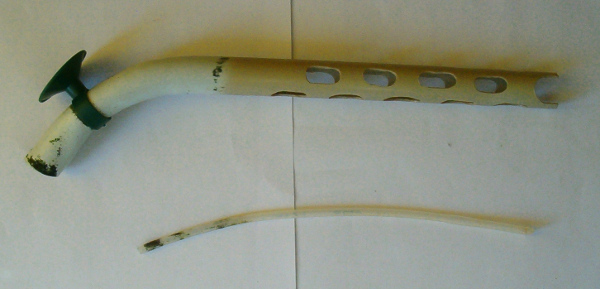
Not just me, but old-school aquarists too, have come to the conclusion that there's nothing better than a foam filter, powered by air from a compressor. Foam filters suit smaller aquariums, and for larger ones you can get "blue foam". After various attempts, I ended up making my own filters, which are much better than the commercially sold ones. The key difference from store-bought filters is the bend radius, which must not be small. So the elbow on the filter tube is gradual, or even absent if the tube is straight - you just need to tilt the filter a little. The optimal tube diameter is 15-20 mm. The small tube that supplies air must be led all the way to the bottom of the filter and ends with a simple cut.
Internal foam air-powered built-in filter
I got a new aquarium with dimensions just under 110x60x60 cm and a volume of over 300 l.
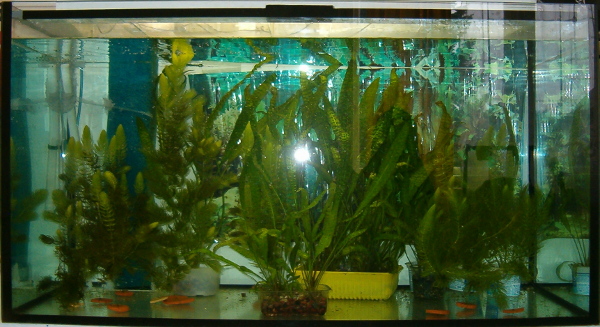
And since I have the best experience with the foam air-powered filter,
of course I planned one for the new aquarium as well.
But given the size, I decided to integrate the filter into the aquarium.
That way there won't be any problem with attaching it, or with such a large filter drifting around on its own.
The implementation plan is as follows:
attach a partition to the corner of the aquarium, which will create a mount for the filter foam and, together with the aquarium walls, another chamber
in which the pipe for pumping water will be placed.
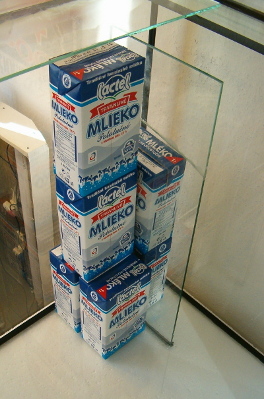

The partition has a gap in it, which I later sealed with silicone, leaving only an opening for the pipe. The partition has to be glued into the aquarium sized to fit the width of the foam, so that there's no gap, but at the same time so that the foam doesn't put too much pressure on it, which could break it. For better placement of the foam and rigidity of the partition, a small extra brace is glued between the large partition and the aquarium wall.
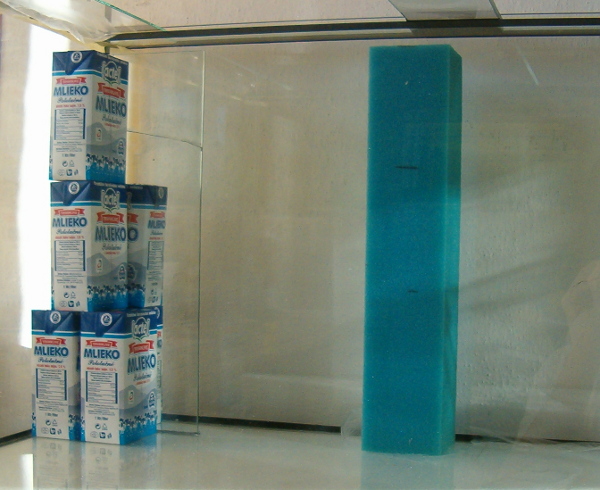
The result can be seen in the following picture:
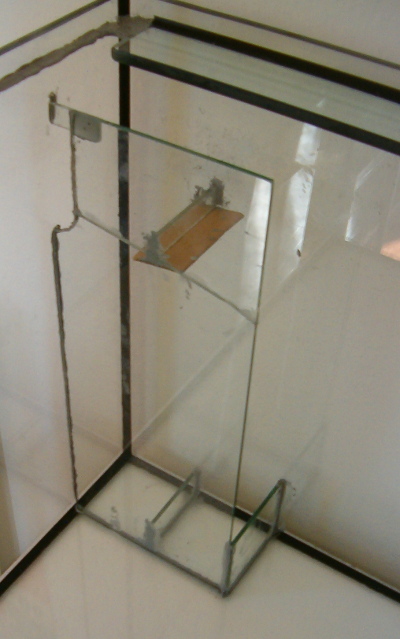
The advantage of a filter like this is, again, trouble-free operation with almost no maintenance. Simple suction of impurities that accumulate near the filter. The filter has an exact fixed place in the aquarium, so it doesn't get in the way anywhere, nor does it move around the aquarium.
In the following pictures you can already see the assembled filter in the filled aquarium:
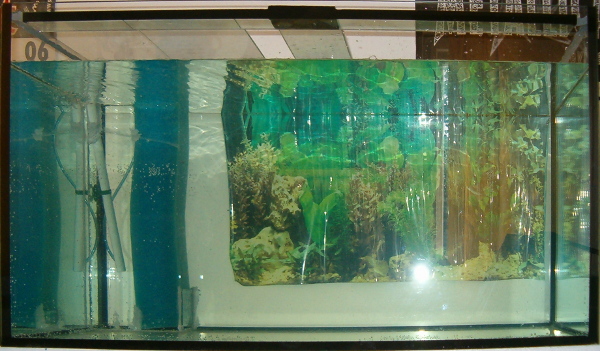
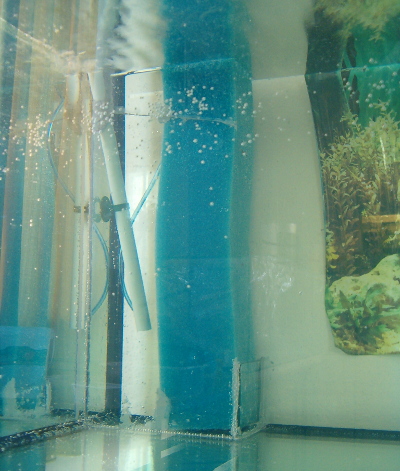
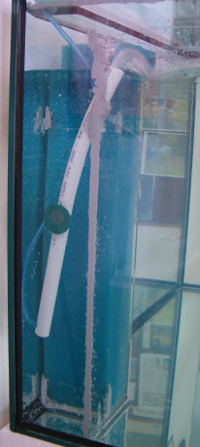
The performance of such a filter is impressive, you just need a powerful compressor,
because with the length of the submerged pipe, more air pressure is needed.
Detail photo of the stream flowing through the filter:
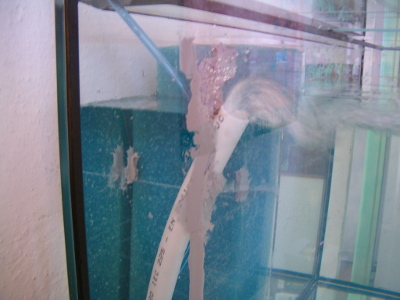
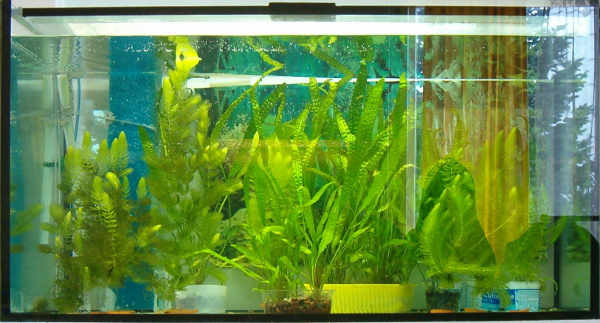
A running aquarium with
submersed hornwort
and
Cryptocoryne aponogetifolia:
The weakest link of the air-powered filter is the end of the small tube that leads air into the aquarium, because something like limescale, or possibly proteins, gradually builds up on its edge, and the tube may narrow over time, which worsens the filter's performance, or the tube may even get clogged. So it needs to be cleaned occasionally too. Every so often, depending on how stocked the aquarium is, the filter media also needs washing, and it always needs to be washed in aquarium water that's been let out and not in clean chlorinated water! In an aquarium like this, the fish and aquarium plants then thrive well.
The length of the tube needs to be chosen appropriately relative to the strength of the compressor, so that it can push the air pressure down to the required depth. Some weak air pumps, in fact, wouldn't even manage it in my case. It's best to place the end of the tube with the filter outlet exactly at the surface interface.
Articles on a similar topic
How to Grow Aquarium Plants
Aquarium Air Pump
Aquarium lighting
Aquaristics
Newsletter
If you are interested in receiving occasional news by email.
You can register by filling in your email
news subscription.
+