




VDSL internet and the Comtrend VR-3026e modem
May 31, 2011I already thought that speeding up the Internet over a fixed telephone line was not possible. But as it turned out, that is not the case. So I ordered a new tariff with a new Comtrend VR-3026e modem and a commitment for another year.
When you unpack the modem, you are surprised at what a completely lightweight little box it is.
The modem does have a design meant to please, but fortunately the author held back and did not fall into any extravagance,
so the modem does not annoy anyone with kitsch and thankfully has a more or less cuboid shape.
What is surprising at first glance is that the modem has no WIFI antenna; the reality is that the modem does have WIFI,
but the antenna is inside the modem.
It is sad that every modem from Telefonica O2 has a smaller and smaller WIFI antenna each time.
When we switched to an ADSL connection, we got
a Zyxel modem which had an antenna above standard, bigger than the ones supplied with WIFI cards, which pleasantly surprised me.
The following modem had an ordinary-sized antenna and now the antenna is just a piece of printed circuit board sealed inside the modem's box.
That is why the WIFI on the Zyxel had excellent range, while with the next modem the signal coverage was already poor even in the next room.
So the WIFI is now only good enough for people who are too lazy to plug a UTP cable into their computer,
even though they are sitting right next to the modem.
Moving around the flat with a laptop is still possible,
but I cannot expect to move any further with a mobile phone
or even a Touchbook,
and yet I would like to have WIFI on the other floors as well and I would wish for coverage in the garden too.
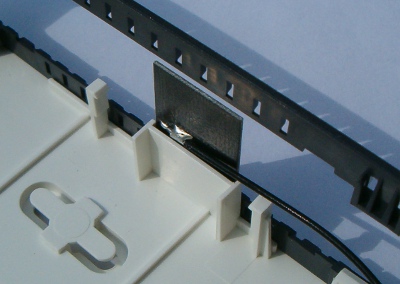
The device is not only quite hard to take apart, but also opens in a very strange way. First you have to unscrew two screws in the front feet, "break out" the side panels, then the side teeth holding the casing together can be released and afterwards the top of the box can again only be "broken out". The box is simply made in such a way that taking it apart is not expected. These days nothing gets repaired, things are thrown away straight away.
Looking at the WIFI antenna and the printed circuit board, a tinkerer immediately gets the idea of connecting a different cable with a connector for attaching a proper WIFI antenna. The cable can even be led out through the side without the need to make a hole in the modem's box.
As can be seen in the following photo, apart from the main components there is essentially nothing on the printed circuit board:
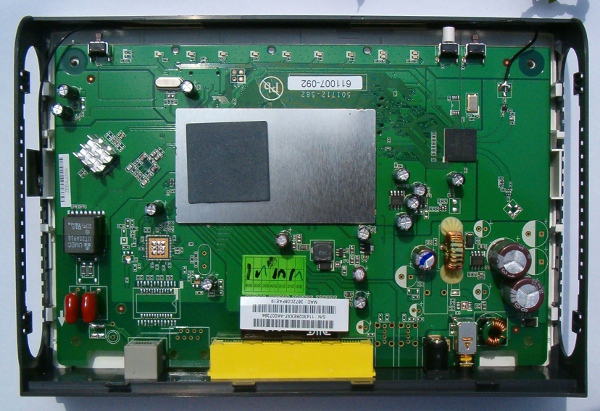
full resolution of the vdsl modem comtrend vr 3026e board
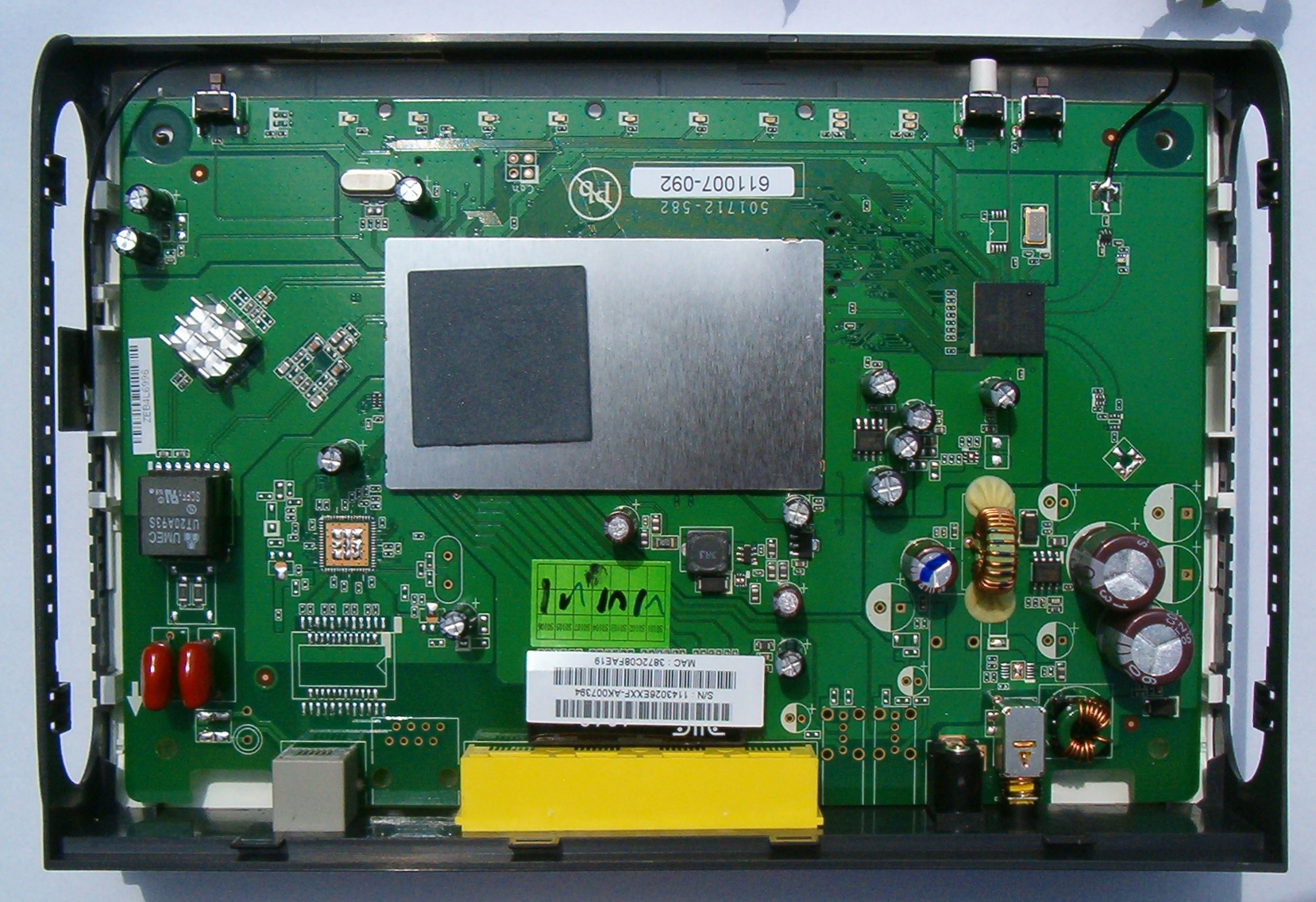
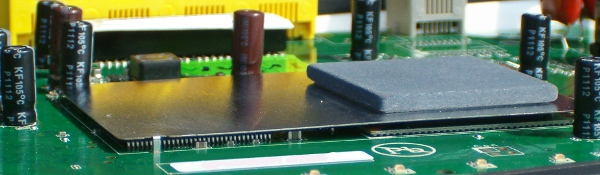
Under the heatsink there is the processor and two modules, I assume they are RAM.
A detailed view under the heatsink:
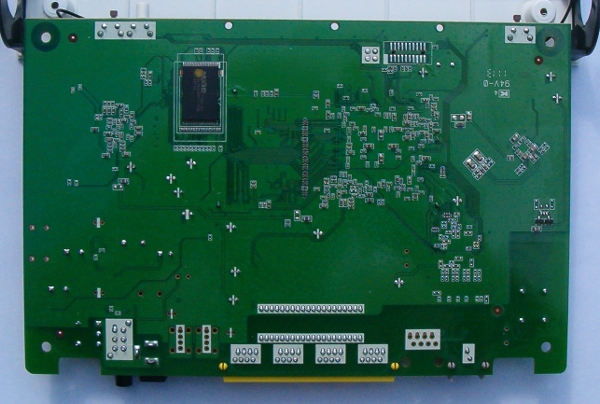
On the other side of the printed circuit board, opposite the WIFI chip, there is one more chip; I can only guess that it is a buffer memory for the WIFI.
Compared to the older boxes, the modem has more configuration options as far as network traffic is concerned.
But when you sum it up, it is still the same as before.
It is not possible to set up everything the way one would like
and everything is limited to a few items.
And yet the potential of the hardware and above all of the system is greater.
The configuration is therefore also illogical for an experienced network administrator (that is probably caused by the simplification for laymen).
So the easiest thing is simply to use the DMZ and better not to deal with anything more :D.
The modem even supports IPv6, but how well is another question, and Telefonica O2 does not support IPv6 yet (that is, May 2011).
It would be great if the modem could create an IP6to4 tunnel and IPv6 would then run natively behind the modem.
The modem even supports access over SSH, but you cannot expect any proper command line,
just a few simple commands that configure exactly the same things as the web interface, but nothing more.
The manual supplied with the modem even mentions the GPL licence directly, so there should hopefully be no problem with requesting the source code of the system and subsequently with hacking the modem. And then getting into it and uploading some system that is pleasant to use for a Linux user.
The result of the upgrade
I was promised a speed of 16Mb/s and, in reality, supposedly a doubling of the speed. This concerns the download; the upload does speed up as well, but it is still miserable. So compared to my current 6Mb/s it should run at 12Mb/s. The modem did arrive home very quickly with the help of the post office. Telefonica O2, however, forgot about switching me over to VDSL. After some urging, it was eventually put right.The current speed is thus 16Mb/s for download and 1Mb/s for upload. The download therefore got 2x faster and the upload even 3x, which also corresponds to what I got from them as a realistic figure.
VDSL should reportedly also be capable of symmetric operation, in which case the upload could be increased at the expense of the download, which would interest me very much, but Telefonica O2 probably does not allow that.
Even so, apart from the WIFI, I am satisfied with the upgrade.
update September 2011 - long-term experience and troubles
After using it for a longer time I am ultimately not satisfied with the upgrade, neither with the modem nor with the service provided.Because the ADSL modem has various limitations, like most of these boxes after all, I turned off most of the services it provides (DHCP, DNS, ...) and set them up and got them running on my own server, which I have in the network anyway. The only disadvantage is that the network now depends on the server. These modems are simply just black boxes that try somehow to connect the user to the Internet, but they do not offer quality services. And here IPv6 comes to my mind again.
I also turned off the WIFI, because my mobile device did not work with this modem. As WIFI I used an old ADSL modem, to which I connected a discarded professional antenna. As a result I probably have even better coverage at home.
After the first trouble-free months, however, problems with the functioning of the Internet arrived. First Oxygen reconfigured something somewhere so skilfully that we were completely without Internet for several days. After many urgings and a short-term repair, the Internet did work again, but since then the connection has been playing up. The Internet shows very frequent outages lasting even minutes. After repeated checks, including a check of the line by a technician, I was told that the only remaining possibility was that the problem lies in the modem, and with that Oxygen's troubleshooting ended. When I dealt with it further, they sent me to make a warranty claim for the modem at the wrong shop. Then I preferred to correspond myself with another shop to find out whether they handle warranty claims and lend out replacement modems, but they do not have any there anyway. What is more, it is funny that although Oxygen's shops are all over the place, warranty claims and lending a modem are only handled by shops on rare occasions, and so I even drove all the way to another region completely in vain.
So for now I do not even know whether the problem is in the modem or whether it is somewhere else, but it does not seem likely to me. I also suggested switching the line to ADSL2 and that I would use the old modem, but they just laughed at me. So for now I probably have no choice but to put up with it and maybe also slowly look for a different and hopefully better provider.
Evaluation of the troubles
Thanks to an acquaintance who also got VDSL, I was able to try out a different modem at home. So despite Telefonica O2's lack of interest, I managed to carry out tests and find out more. Unfortunately it turned out that I was not mistaken and the problem persists even with a different modem and is somewhere at Telefonica. Out of sorrow I even wrote myself a monitoring script. From the results it was clear that the modem does not freeze, but the connection keeps being interrupted, specifically in Telefonica's network. The conclusion is therefore that my assumption was confirmed, that the fault is not "in my receiver".The Internet service that Telefonica O2 provides using VDSL technology is problematic in their rendition, which is actually no news and there is plenty of merry reading about it on the Internet :-D :-( . For most people who just look at the web it basically does not matter, but for more advanced users who use the Internet to the full it is a problem! (it must also be a problem for gamers)
In the meantime I have had my eye on another Internet provider, one with IPv6, which is a motivation to switch. But a change also means an intervention in and an investment into my network infrastructure, which one is reluctant to do.
Over the last two weeks the Internet has been playing up less. Could it be that Telefonica found out it had deployed the VDSL badly and is now sorting it out? So maybe it will be OK again and I will leave it be......
Articles on a similar topic
Lenovo Thinkpad P14s battery life and UEFI/BIOS flashing
Industrial computer IPO ODYSSEE 18WT
Which mouse to choose for my computer?
Samsung S24H850 monitor
TUXEDO Pulse 15 - Gen2
How to connect a computer to a mobile phone running Android
Data backup
Embedded World 2016
Banana Pi R1 case
Computer with MSI B85-G43 motherboard and Intel Xeon E3 1226 processor
Single board ARM computer Banana PI R1
How to use an SSD and TRIM
Using TouchBook in practice
Compal FL90 and GNU/Linux
ThinkPad 600 with GNU/Linux
Replacing the heatsink on the chipset
Thermaltake Matrix VD2000BNS computer case
Disassembled computer disk
WIFI
HP photosmart 735 digital camera
Newsletter
If you are interested in receiving occasional news by email.
You can register by filling in your email
news subscription.
+