




How to Grow Aquarium Plants
September 14, 2014
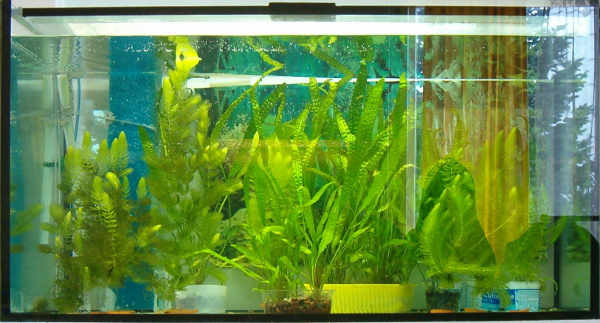
A beginner self-taught aquarist buys aquarium fish and basic aquarium equipment, but doesn't buy aquarium plants. However, an aquarium with fish but without aquarium plants is an empty aquarium. Aquarium plants also help maintain proper conditions in the aquarium. In an aquarium that's filled with plants, the aquarium fish feel better too.
How to grow aquarium plants
Aquarium plants basically don't need any special care compared to aquarium fish. The only fundamental difference is lighting. Plants need the right intensity and duration of light. For this purpose, above every aquarium with plants there's aquarium lighting, which provides light for the plants, and not just so that the fish are easy to see. Aquarium plants can't do without aquarium lighting! There's no need to buy expensive aquarium fluorescent tubes; on the contrary, special tubes are just a waste of money. Ordinary, cheap, readily available fluorescent tubes are enough. It's better to buy tubes with a warm (yellow) light spectrum.
Just like fish, plants also benefit from a particular water acidity and hardness,
and so it can happen that in your aquarium some plants grow worse than for someone you know, and vice versa.
Even if there were no fish in the aquarium, you'd need to ensure quality filtration, i.e. an aquarium filter,
which handles the breakdown of fish waste,
where bacteria on the filter break down more complex substances into simpler ones, which the plants then use for growth.
In the end, the plants then provide a better environment for the fish too.
Some plants need to be rooted in order to grow successfully, while others grow freely.
Some plants need to be planted, but at the same time, when planting, you need to make sure
that the junction between the root and the stem (the neck) stays above the substrate of the aquarium.
Some plants do have roots, but even so they mustn't be planted in fine substrate,
because the roots need to be rather loose, though they're still used to attach to a root or larger stones.
As I already mentioned, aquarium plants are often planted into substrate.
The substrate in an aquarium, though, with a few exceptions, isn't soil or sand - it's fine gravel,
where the pebbles are between 5 and 10 millimetres in size.
Limestone rocks or crushed limestone are, with a few exceptions, unsuitable.
Personally, I don't plant into little baskets, let alone into "cotton-wool"-like mineral rooting material,
of the kind commonly available in aquarium shops.
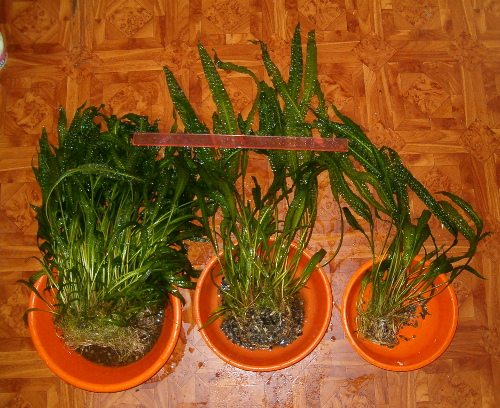
I prefer planting into various food containers that hold the substrate.
Usually these are plastic tubs from butter, ice cream, or cottage cheese.
The advantage of this is that the aquarium is easier to maintain, and the plants can also be taken out easily.
This way you can excellently
grow aquarium plants submersed
and transplant them quickly and successfully without any problem.
Suitable plants for beginners
For a newly set up aquarium, undemanding aquarium plants that don't have a root system are suitable.
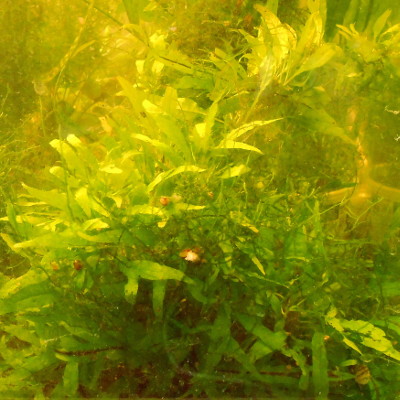
One such plant is Java moss, Vesicularia dubyana.
Java moss is an undemanding plant,
which is also often used for the spawning of aquarium fish.
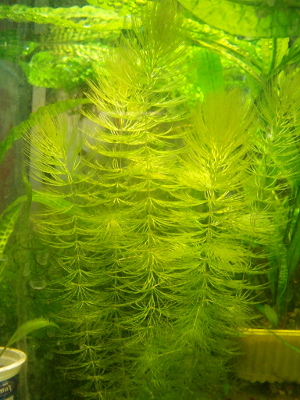
Another non-rooting plant is
submersed hornwort Ceratophyllum submersum.
It's an undemanding plant that grows upward toward the surface of the aquarium; to anchor it I like to use fishing line and a larger pebble.
Rooting plants are: red cryptocoryne - Cryptocoryne affinis,
Cryptocoryne aponogetifolia Cryptocoryne aponogetifolia.
Cryptocoryne aponogetifolia is a very pretty plant,
which grows to large sizes; the mother plant commonly has leaves as long as 1.5 metres.
Red cryptocoryne
is a plant capable of growing even emersed (risen out of the water),
which is its natural way of growing at times when the water level has receded.
So with this plant, it apparently happens
that when you buy an emersed-grown red cryptocoryne at an aquarium shop,
after transplanting into the aquarium the plant first has to shed its leaves and let new ones grow, and in that case it can happen
that the plant never recovers from the transplant and dies.
However, the problem can also be caused by a reaction to a big change in the water environment;
in that case too, holes can appear in the leaves of the red cryptocoryne.
Cryptocorynes multiply by rhizomes, and that's also one of the reasons they're trouble-free to grow.
Java fern Microsorum pteropus - is actually a fern.
Java fern
is best grown
by attaching it to a root or a stone.
Dwarf anubias Anubias barteri var. nana is a very pretty plant with roughly round, thick leaves,
which is why it's a favourite among aquarists whose fish eat their plants.
Dwarf anubias
is already more demanding and grows very slowly, so I'd recommend it only for well-established aquariums.
Fertilizing aquarium plants
In a well-functioning ordinary aquarium there's no need to fertilize the plants. Nutrients are brought into the aquarium in the form of fish food, and the fish then fertilize the plants.
Aquarium fish and plants
Some aquarists have a problem with plants when keeping certain fish. For example, they claim that their ancistrus catfish eat their plants, but the problem is actually caused by feeding the fish incorrectly. Ancistrus catfish feed mainly on plant matter, and so when keeping them you need to make sure to feed them properly with supplementary food.
Articles on a similar topic
Aquarium Air Pump
Internal Air-Powered Foam Filter for an Aquarium
Aquarium lighting
Aquaristics
Newsletter
If you are interested in receiving occasional news by email.
You can register by filling in your email
news subscription.
+